Why a Device Stops Before a Cell Is Empty
A battery can still show a voltage when a device refuses to run. The limit that matters to the device is usually what the battery can provide while doing work.
In this story 5 sections
A small lamp stops shining, and its owner puts one of the cells into a tester. The tester gives it a reading. That can seem contradictory if a battery is imagined as either full or empty, like a jar somebody can hold up to the light. There was apparently something left. The lamp still stopped where it usually gives light. A short account of the difference needs to keep the battery and the lamp together long enough to consider what the lamp was asking the battery to do.
The number on a battery label is generally a nominal voltage for its type, not a guarantee of the same voltage under every condition. The operating voltage can change with the load, the condition of the cell and its chemistry. A device can stop accurately detecting an input, dim or shut down when it no longer has an adequate supply. At that point another device with different requirements might behave differently with an otherwise suitable cell. Such differences tell you something about both pieces of equipment, not just about the cell from which one reading was taken.
Keep a measurement with its conditions
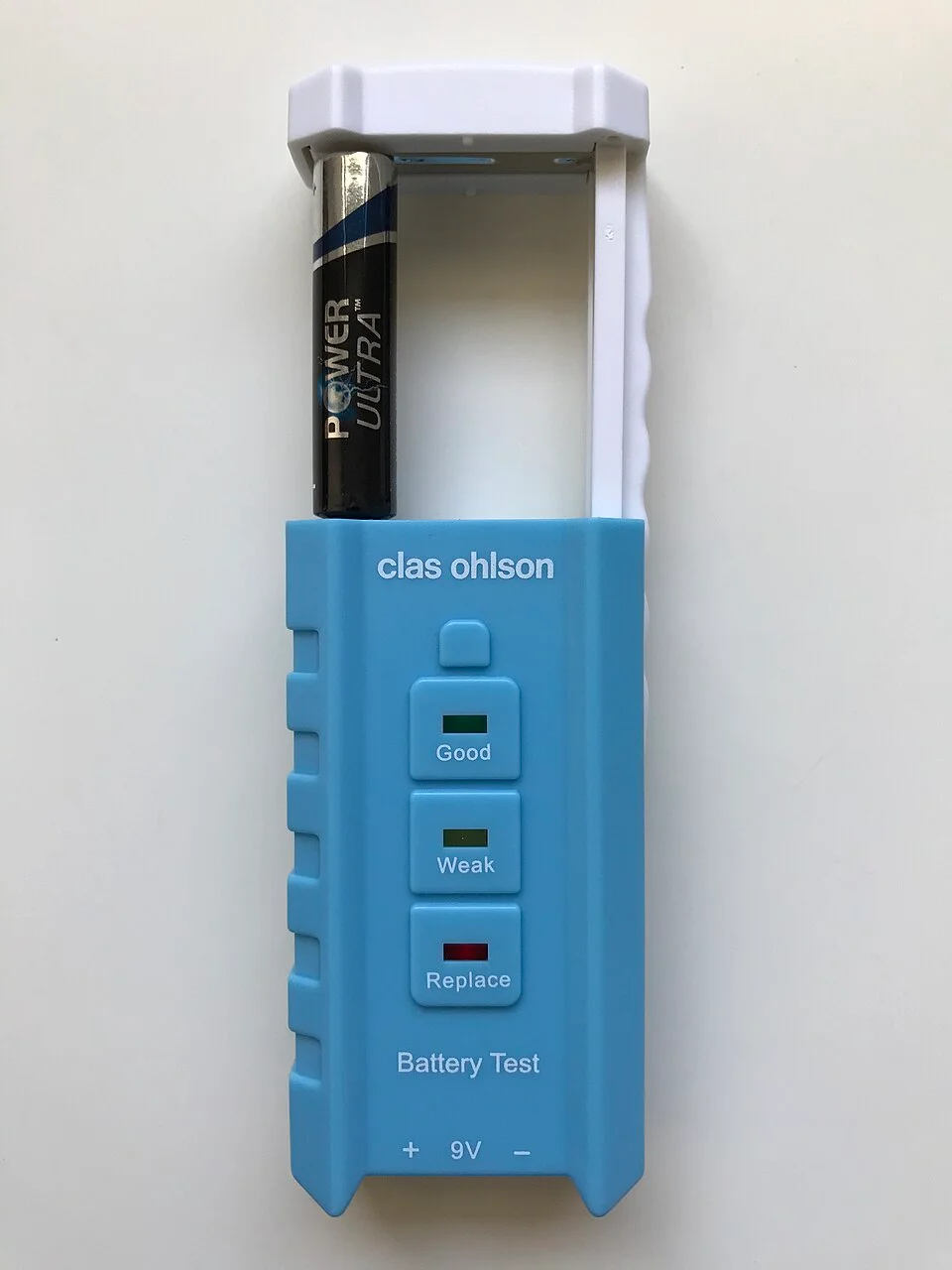
A voltmeter drawing very little current from an isolated cell can indicate something close to an open-circuit voltage. A load tester may put on a specified load during its test. The voltage seen while a device draws power can differ from either reading depending on how the measurement was made. Those statements are much more useful than trying to turn any voltage one sees into a universal percentage of capacity. The tester in the photograph illustrates one tool. Its indicator has meaning within the tool’s intended batteries and measurement conditions.
For a rough mental model, give a cell an ideal source of voltage and an additional resistance inside the same box. When current goes through a resistance, there is an associated voltage drop. A high-demand load can make the terminal voltage dip more than a quieter load would. Real cells are more complicated than this model and can respond differently over time, with temperature and as they are used. The simple drawing already gives you one useful result. A cell’s apparently respectable reading while almost nothing is being asked of it is not sufficient evidence about what will happen when a larger load needs power.
Suppose an imaginary device would stop at 1.10 volts under its operating conditions. A hypothetical cell has 1.24 volts measured with very little demand and falls to 1.04 volts under a relevant load. There is no contradiction in saying its first reading is above the device’s threshold and that it cannot run the device in the condition given. These numbers are for illustrating the relationship. Neither value is a universal replacement criterion. Consult the actual device and tester documentation for the appropriate type of cell and checks.
Capacity belongs to a test, not merely to the cylinder
Ask whether two testers are intended to answer the same question before expecting them to agree. One may offer a rough comparison at a particular moment. An engineering discharge test can keep a specified load on the battery and measure its behavior until a stated endpoint. The result can be used to talk about how much charge was delivered in those conditions. It does not establish that there is the same usable amount under every possible demand. Manufacturer application manuals give discharge information for specified conditions precisely because the result depends on choices about the test.
Notice what a cutoff does to a reported quantity. A device whose electronics can operate down to one voltage may use a different part of a discharge curve from another that stops sooner. If the test keeps going to a lower endpoint than is useful to the device, the result can report additional capacity that the device was never going to use. This is not a bad measure. It has an endpoint that should travel with the number. If a label or plot omits the load or endpoint, a carefully printed figure still cannot answer the whole runtime question.
Intermittent operation matters too. A device can spend most of its time with quite small demand but ask for substantially more during a short event. Watching the quiet period can miss the moment it actually fails. A lamp may be less demanding after its initial behavior, a motor may need a brief burst, or a device with a display may be doing extra work only at one part of its cycle. Do not force these into fixed rules about all examples of each kind. The point is to watch or document the conditions under which the symptom occurs and to compare like with like.
Nominal shape is not a specification for compatibility
Cells that fit the same physical space can have quite different intended uses. Chemistry, voltage characteristics and safety instructions matter. Use the types and arrangements the equipment calls for. Do not assume that a cell from another chemistry is appropriate simply because it fits or because the printed number looks close. A real manual is also the appropriate source for how to replace a group of cells. Picking an improvised combination in which some are fresh and others are not is a poor way to make a known comparison.
There is a narrower role for observation. If a device stops with a partly depleted set of appropriate cells, note what action it was taking and whether the symptom changes with a known good set installed according to instructions. If it remains, consider other ordinary possibilities such as supply contact problems or a fault in the device, without treating a first reading as proof. An intermittent fault might be visible without any relationship to the measured battery capacity. Stronger evidence keeps the pieces and conditions as consistent as the question allows.
A cell can also behave differently after sitting apart from a load for a while. Comparing a reading immediately after use with one taken much later can hide a short drop that mattered to a device. Associate time with the comparison just as carefully as the instrument. When a supported tester shows a coarse status instead of a precise value, let that result remain coarse. A single green region on a dial is not a detailed report of the energy a device will be able to use over an evening.
Charge and energy are not quite the same question
Battery literature can express delivered charge in ampere-hours or milliampere-hours. Energy takes account of voltage as well. Two cells offering the same amount of charge under their respective test conditions do not necessarily deliver the same energy, and a device may only use part of that delivery. Compare numbers that describe the same quantity before drawing a conclusion about run time. A precise figure at the end of an application note belongs to the load, cutoff, conditions and chemistry with which it was measured. Another number with the same unit can belong to a rather different trial.
For a fictional calculation, a supplied current of 100 milliamperes maintained for four hours would amount to 400 milliampere-hours of charge. That arithmetic does not tell you how the voltage behaved over those hours, what losses a device incurred or whether the original cell could continue delivering that current for four hours in the first place. If a required supply voltage was reached after two hours under the relevant conditions, the device and the cell together got a different useful runtime from the simple example.
Make a tiny table for comparison: intended type, test conditions, observable symptom and what the replacement changed. Keep the label’s nominal voltage in a separate field from the tester’s readout. If the tester does not provide an interpretable numeric result, do not fill one in. A future reader can still use the record to compare an equipment check with the relevant manual.
This distinction also explains why a device may offer a warning in advance rather than waiting for a completely silent battery. The warning threshold is chosen to fit what the equipment can do reliably.
Follow the point at which one result turned into another
Return to the lamp and keep a simple record. Under what condition did it go off? What was the battery type specified by the maker? What did the tester actually apply and display? Did an appropriate replacement change the outcome? Those questions are conceptually different. If the new cells worked normally, the first set may have been unable to provide the required supply under the relevant load. If there is no change, the battery is not necessarily the right place to continue looking. This modest order of inquiry is more useful than asking a device’s on-or-off state to function as a battery analyzer.
Two tests can even be perfectly accurate at the same time they appear to contradict each other. One measured an isolated cell under the limited demand of the measuring itself. Another describes how a device behaved during actual work. The practical answer depends on where those demands fall on the behavior of that cell. A decent tester, a specified method and a clear account of the symptom make it possible to discuss that gap without having to imagine a jar that was somehow both full and empty.