The Paper That Prints Its Own Receipt
A direct thermal printer supplies heat rather than ink. The paper has a coating that darkens where the head touches it, so a wrong roll can look fine and leave the printer blank.
In this story 6 sections
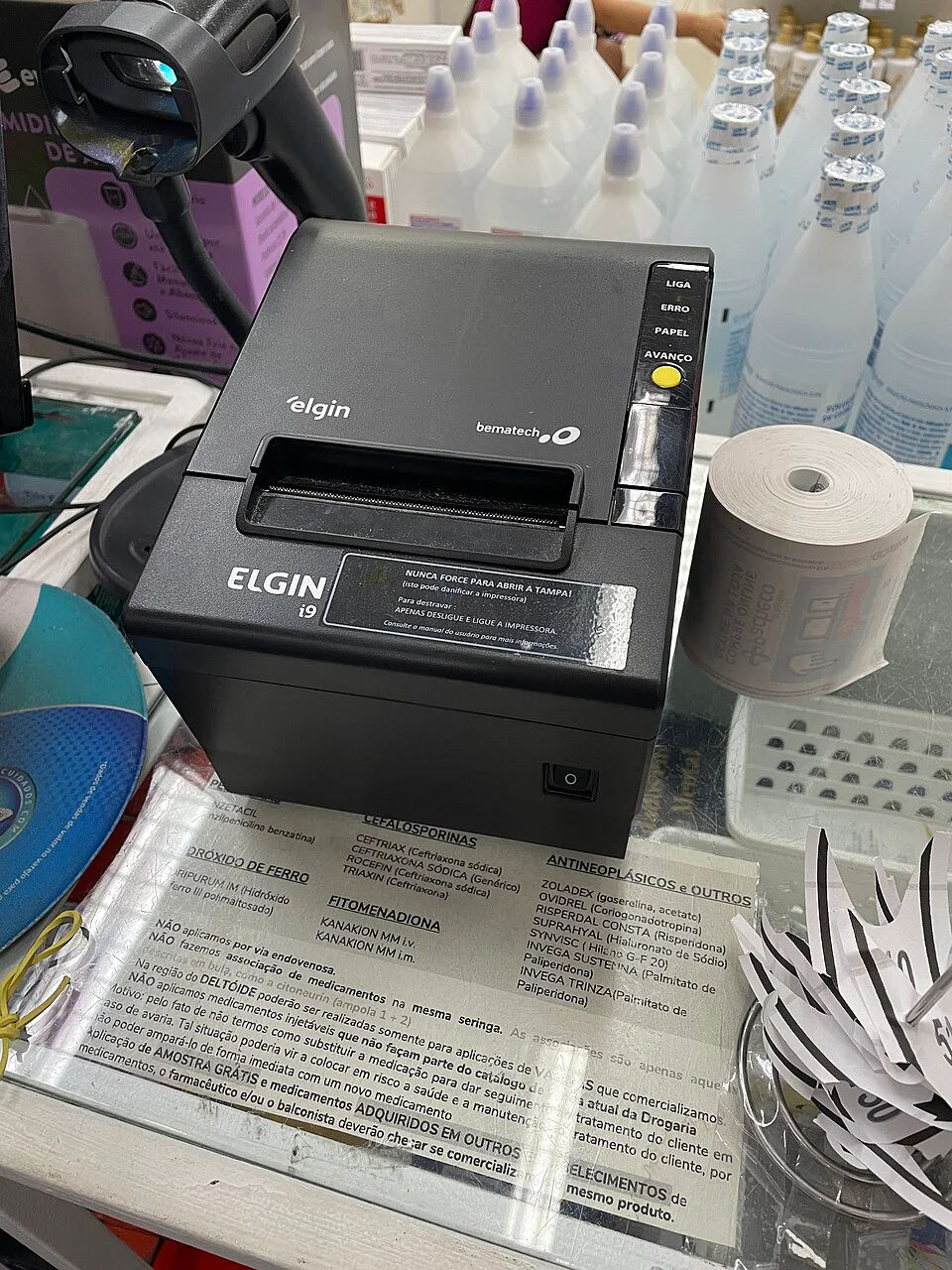
The thermal printer in Guigag1’s photograph is a small dark machine with an outlet at the top. Its shape tells a person about the width of the material it can handle, though not about the process that puts dark marks on it. Take out an empty roll and one might look in vain for a cartridge to replace at the same time. A direct thermal mechanism can make its marks without an ink supply because the consumable doing the work of marking is the paper itself. Buy a roll that looks the same and lacks the right coating, and the feed can run without producing useful text.
The term thermal printer covers more than one process. This article follows the direct thermal kind used for many receipts and labels, and distinguishes it from machines that use heat to transfer material from a ribbon. The ingredients of a coating and details of the print controls vary. The common point is that heat can be delivered to a small position at a known time. If the rest of the system keeps the medium in the right place, a moving strip can acquire orderly letters, bars and other dark forms over its width.
Follow one row of marks across the paper
Imagine a narrow line of elements in a printhead. Each can warm a small marked position when it gets instructions to do so. The coated surface passes against or near the line where heat is applied, depending on the details of the machine. Heaters for the dark portions of a row make those parts of the medium change. The paper advances and another row can be made. The rest of the previous row can remain pale. There need not be a separate stamp cut in the shape of every character or a pen moving back and forth to draw its outline.
For a rough picture, think of making a capital letter out of a few rows of dots. At one height it might need a short dark run across the middle. At another it might need two dark points farther apart. Time and position work together: the head decides which points across the paper to darken while the feed determines which row receives them. If the feed moves the paper inconsistently the resulting marks can be stretched, crowded or disrupted even if the instructions for the letter are correct.
The rated resolution of a print mechanism says something about the fineness of the positions it can address. Useful detail also depends on how readily the material responds and how accurately the mechanism moves it. A barcode relies on differences among widths and on contrast. Darker marks are not always the sole goal if changing the way a printer applies energy also changes their apparent edges. A sheet that appears strikingly dark may not be the one whose narrow spaces are easiest for a reader to distinguish.
Two methods start with a warm head
Zebra’s technical overview calls the change on the coated material direct thermal. It also describes thermal transfer, where heat at the printhead transfers material from a compatible ribbon to another surface. The two names relate to where the final colour comes from. In one case the coated medium develops the mark in place. In the other a separate consumable supplies material that becomes part of the mark. Both employ a heated head. Seeing the word thermal on the cover is not enough to tell which roll and supplies a particular printer needs.
The distinction is useful in a stockroom. A box marked for thermal use can be the wrong thing for a printer if the type, size or other characteristics do not match. Even a suitable direct thermal roll generally needs its sensitive face oriented where the head can act on it. The reverse side may look quite similar in ordinary light. The first question when a receipt feeds through blank is therefore not whether the device has run out of something invisible. A safer, quicker start is to confirm the media fitted for the machine and which way its maker shows the roll should face.
The reason for choosing one process over the other can be related to the job the mark will do later. A short-lived label that only needs to be read during an internal movement has different needs from a label someone must read after prolonged handling or exposure. Direct thermal images can be affected by conditions such as heat or strong light; a particular media specification and intended service matter. Thermal transfer also has material choices of its own. There is no useful way to promise the life of a document from the name of the head alone.
A pale result is a clue, not a verdict
A print can fade or look weak immediately for more than one reason. The head and paper need an effective path for heat to reach the intended spots. Dust and ordinary wear can affect what the machine does, but so can the selected medium or a control setting. Another kind of fault can affect the way material moves through. Watching the result before guessing is worthwhile. A completely blank roll that moves normally gives a different observation from a rotating roll that never reaches the exit, or from a print that carries text except for a regular pale stripe.
A stripe running along the length of a succession of receipts has an interesting relation to the head. It can correspond to a position across the print path that is repeatedly missing or weak. This observation does not prove which piece has failed. A different layout or a sample offered by the printer's own controls can help distinguish missing source material from a problem across the print path. Follow the supplied cleaning or service directions rather than applying a strong solvent or an improvised tool. The surface that transfers heat and the path that holds the paper both have roles beyond what a stain on the receipt shows.
The density or speed choices in an ordinary printer can also have visible effects. They can relate to how much energy is applied and the time the paper spends near the head. A good result is obtained with settings appropriate to that material and purpose. Turning everything to the strongest possible value is a poor general answer. It sacrifices the chance to diagnose why output changed, and can make a fine rendering harder to read even if the text looks bold.
Think about the information after it leaves the slot
A receipt might need to remain available after the paper ceases to be the most convenient way to read it. Someone storing an important record may use a legible digital copy or obtain an electronic record when it is offered. Checking that the copy shows the details actually needed takes less time while the original reading is clear. The paper and the record have different uses. A photo or other copy can outlast a thermal mark without being the authoritative record for every purpose. Keep the evidence suitable for the job instead of assuming a faded slip can always be restored later.
Handling is connected to the same physical property that made the printer possible. The visible effect came from material responding to heat rather than from dark ink laid on top in the ordinary way. Later exposure to heat and light can therefore matter to what remains legible. It helps to treat a roll in storage and a receipt in use as a specified material with limits. A printer in two different environments can behave differently if the supplies have been kept or handled differently. A box label and ordinary visual checks are simple evidence to compare before deciding the machine itself changed.
Compare the instruction with a known sample
An internal sample provided by a printer can be useful because it does not begin as a file sent by the till or another computer. If the sample prints clearly and a particular job doesn't, the difference is a reason to inspect how the job was sent and what it asked the printer to do. A blank result in both cases does not prove a failed head either: the two jobs may be sharing the same wrong roll. The value of the two observations is that they let somebody vary one part of the arrangement while keeping other parts recognizable.
A support request is easier to handle when it makes that comparison explicit. It can identify the roll in use and describe whether ordinary paper movement, printed characters and a known sample all behaved alike.
Separate the roll, the feed and the mark
Return to the little outlet in the photograph. The paper coming through has had to follow a path and make good contact at the right position. The design has to move it forward at a rate that leaves room for a sequence of marks to form. An apparently simple receipt depends on all three things. The feed moved the roll. The printhead delivered heat. The coated surface changed where it received it.
That division makes a very compact machine easier to understand and a weak receipt easier to describe. If the strip moved but remained blank, start with the medium and its relation to the head. If the information is missing in one regular region, keep track of where that region is. The needed evidence is often right where the file's instructions turned into marks. The slot is where that result becomes visible, a row at a time.