The Switch That Responds Through Glass
A glass tube can hold dry contacts that move when a nearby magnet changes position. A rain gauge gives the small switch a larger job: turning tips into countable events.
In this story 5 sections
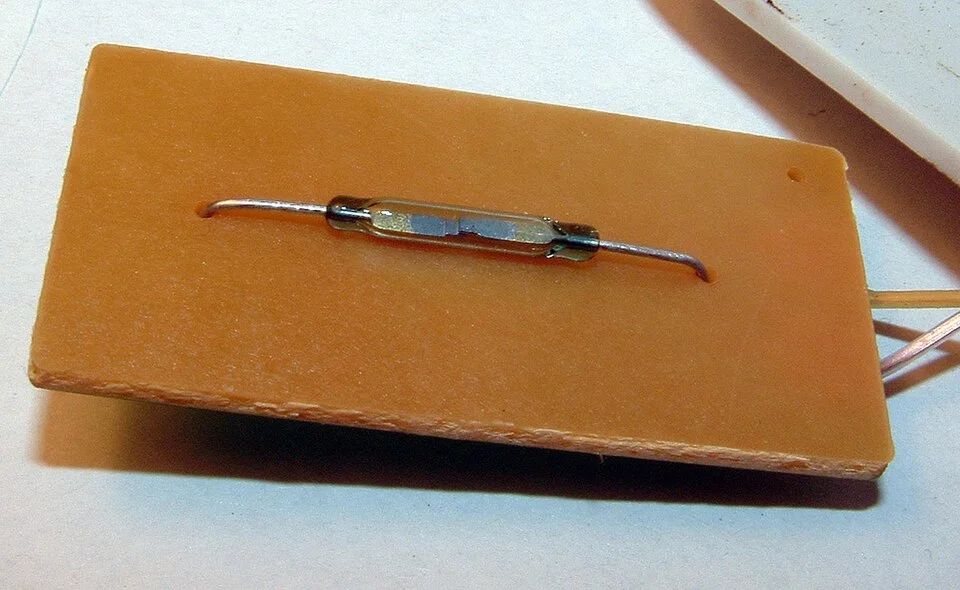
A glass tube on a circuit board gives almost no clue that something inside it moves. Two short strips of material are visible. They are fixed at their outer ends, draw close near the middle and have no knob a person outside the tube can press. The switch can nevertheless change state without anybody making a hole in the glass. A magnetic field reaching the right part of the assembly can do the work from outside. The turn is not limited to novel gadgetry. That little action lets equipment count physical events in places where a button pushed by a human would be quite an unsuitable instrument.
The photograph shows a reed switch on a board in a tipping rain gauge. The small glass assembly belongs to a machine for measuring a large and often inconvenient process. A bucket collects a known amount of water and tips. The movement can make a magnet travel near a switch. The switch briefly changes its electrical state, and a logger can record the occurrence. A count out at the far end does not have to be a miniature model of the thing that happened. It can be a carefully chosen sign sent by one part of the machine at a time when another part has something useful to say.
Separate the switch, the activator and the circuit
A simple normally open dry reed switch has two flexible magnetic contact members sealed inside a tube. Without the controlling field close enough in the intended orientation, the contacts in that example are separated. When the field produces the needed forces in the reeds, they can meet and complete an electrical path. When the field is removed sufficiently, the reeds separate again. Other switches and assemblies can provide different normal states or ways of using the change. Read the identified component’s documentation before assigning a state to something on an unfamiliar board.
The magnet does not send the logger an electrical command through the air. Its field changes the condition of the contacts. Wires or circuit paths then make that condition available to another part of the system. Draw an arrow from the moving mechanical part to the magnet and one from the closed contacts to the counting circuit. It is an easy way of seeing how a mechanical jam and an electrical break can both give a disappointing final number while occurring at completely different places.
Protection and the means of making a movement are separate issues. There is no need to put the magnet or the external lever into contact with the clean surfaces inside the glass. At the same time, the little tube, wires and support are physical parts subject to the conditions of the product. A cracked tube, broken connection or incorrectly placed activator can matter. If you are learning from a board, leave it in its equipment’s intended state for inspection, keep track of the corresponding documentation and avoid assuming a part needs to be bent or dismantled merely because a signal is absent.
The count says when something crossed a threshold
In a tipping bucket rain gauge, water fed into a small vessel can cause a balance to move in a way the sensor detects. A related mechanism puts another receiving part into place and lets the process repeat. The Campbell Scientific documentation describes implementations in which each tip gives a momentary closure that data-logging circuitry counts. A series of contacts then provides a way to calculate an amount of precipitation according to the gauge’s specified conversion. The switch itself did not have to measure a volume. It marked when a distinct mechanical event occurred.
Take an invented gauge for which one recorded tip represents half a millimeter of rainfall. Six qualifying tips would give three millimeters according to the model. If a little water remains in the bucket at the end of the period but did not produce a tip, the count has not tried to report the partial amount. This is an ordinary feature of measurement in small units. The event record has a resolution and a time convention. The next tip may move an apparent increment into the next reporting interval, even though some of the relevant water fell before the first interval ended.
Distinguish the conversion for a particular gauge from the value chosen for a simple example. The size of the inlet and the mechanism under it affect what the instrument counts. A product from another family may produce a different number of pulses for a given amount of rain. A counter configured for the wrong value can produce a very neat record with a systematic difference. Confirm what the recorded quantity represents before using its neatness as evidence of calibration.
Distance is only one part of the triggering condition
Look at a magnet and reed as objects with direction. A drawing of an equal distance at two different positions does not establish that the relevant magnetic field has the same effect on the reeds. The Littelfuse application note discusses the importance of arrangement and movement to sensor activation. A single piece of guidance about distance may belong to a specified magnet, geometry and switch. A sensitivity range in a catalog is not a universal gap a repairer can reuse in every mechanism. The switch and the movement were selected to have a relationship.
There can also be a difference between where the contacts close as the magnet approaches and where they open when it leaves. In an arrangement that passes the switch quite briefly, the resulting closure needs to suit the electronics going on to count it. In an arrangement intended to indicate that something is at rest in a particular position, a more lasting closed or open condition could be expected. These are different jobs. The ability of one contact pair to do both under distinct designs is a reason to ask what the system expected to detect rather than declaring every brief event to be a fault.
Contact behavior can matter over the moment of operation. A mechanical pair of contacts can produce a brief irregular transition. A counting design can address the distinction between the intended event and incidental extra changes. Check what the equipment expects and measures instead of interpreting the raw behavior of an unidentified input as a finished account of the weather. This is one reason the button-like drawing of a switch is easier to understand than the problem of making each operation count exactly once in the final record.
When the event travels farther than the switch
A measuring circuit can put the contact far from the place that displays the result. The person working near the gauge sees the mechanical parts. At a recorder the same motion may appear as an entry in a log, or simply as an increase in a running total. If an expected entry was lost, find out whether the recorder normally logs a time for each closure or only reports the count at the end of a period. Those histories are different evidence for the same number. A failure to find an individual timestamp can be entirely normal for the way the system was set up.
The duration of each closure is another property to keep separate from its frequency. Imagine regular closures as a mechanism runs, then imagine one that stays closed for the whole period. One instrument might display the state continuously; another can count a transition and give a very low total while showing no further movement. A useful record says which of those things was measured before deciding how it relates to an observation at the moving part. The glass capsule does not choose how its output will be counted once it is in the rest of the circuit.
A zero has more than one cause
When a recorder says there were no tips, the cause could simply be no rain. It could also mean no water reached the collection mechanism, a movement failed to pass the detector as expected, or events were not recorded on the electrical side. Begin with the other evidence available under the instructions for the instrument. The person observing the result may have access to a record of ordinary operation in comparable conditions or to another measurement. The zero is a report of what arrived in a particular data stream. It is not a diagnosis of everything from the funnel to the file.
The same reasoning applies to implausibly many events. Before saying it rained at an extraordinary rate, check what the counting system counted and the conversion used to interpret it. An instrument sometimes needs more information than a rain chart supplies: how its collection time was set, which component was changed in service, and what information the maker gives about the valid way to check it. A set of notes at that level can keep a difficult afternoon from becoming a speculative account of a more difficult storm.
Return to the board and the two ends of the glass tube. A thin physical connection can be made without a gear or lever reaching directly into the enclosure. On one side of that small event is the movement of a mechanism. On the other is a count that can be organized by the hour. The switch is useful because it promises neither an entire weather record nor a direct look at falling water. It gives the larger system one practical way to know that something it was waiting for has just happened.