The Frame a Slate Lets Two Recordings Share
A slate gives the camera a visible instant and the sound recorder an audible one. An editor can line those instants up, then check whether the recordings stay together.
In this story 6 sections
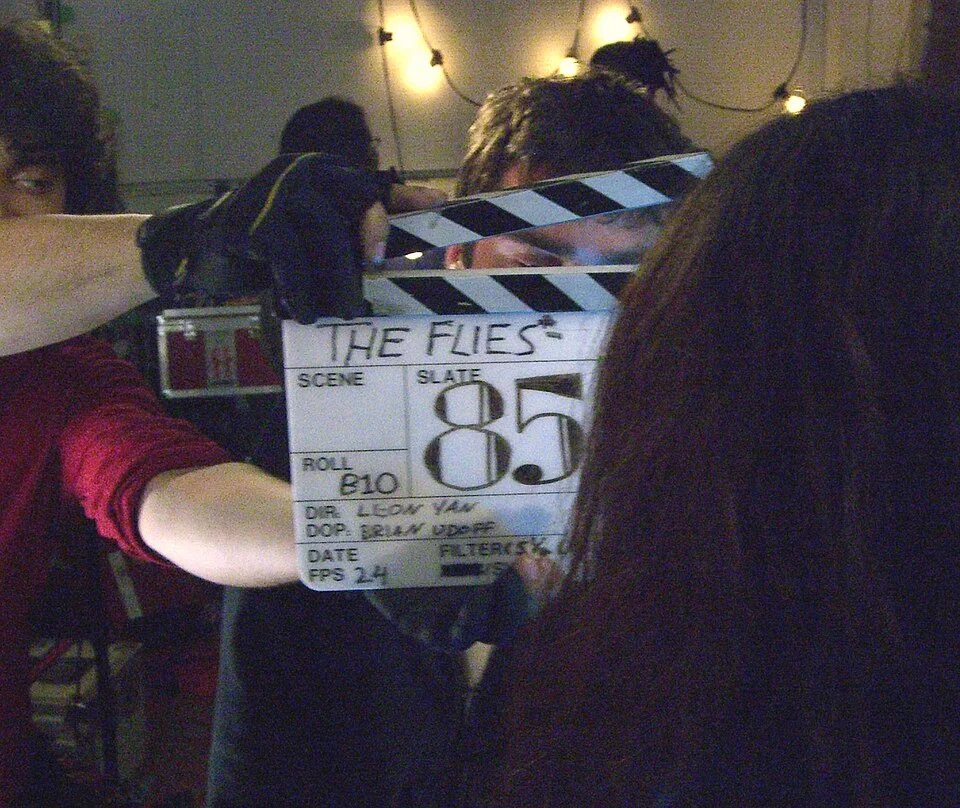
A clapperboard leans into the shot in Girolamo Savonarola’s photograph from the short film The Flies. The upper stick can swing down to meet the edge below it. Written details give the crew another way to describe which work is about to be recorded. In this picture the board has not made a sound anybody can hear. It is a still image. The reason it makes a useful object to include in moving footage is that the contact of its two parts can give a camera and a recorder separate evidence of the same short event.
When a production has separate sound and video equipment, one device might begin saving material a few seconds before the other. They don't have to agree by accident, provided there is a way to recover the correspondence later. The sharp clap gives sound a distinct mark. The camera sees where the sticks come together. The editor does not need either file to begin at the same instant or end at the same time. One recognizable event present in both can supply a reference from which the performance that follows will be easier to assemble.
The picture and the sound can meet at one event
Imagine a scene with the camera already running. The independent audio recorder starts a little later. Without a marker, there may be a long quiet interval in both records and no easy way to tell which portion of quiet accompanies which. Then the board closes. A still image taken from the video just before it closes shows a gap. A later one can show the sticks in contact. If the microphone picked up the event cleanly, the recording will have a short conspicuous change in level elsewhere on another timeline. Both files contain something an editor can find without making any assumptions about where their beginnings ought to align.
It is useful to look at what each observation does. The image gives a visual limit on when the contact occurred. The sound gives an audible marker recorded from a particular microphone position. They were not collected by a common instrument at a shared file index. Put a reference mark on each and move the clips into a position where the marked moments correspond. The silence and movements before and afterward will then occupy a more sensible relation to each other. If the wrong slate or take has been selected, that arrangement can still fail to match the details. The clap is a powerful cue when the right two records have been brought to the comparison.
The written part of the board helps with that earlier decision. A scene or take label is useful for matching groups of files before looking for the transient. It is a record of what was intended to be captured, which someone holding only a waveform would not easily guess. A printed line doesn't automatically put the audio in sync, and a recognizable clap doesn't automatically identify one take among a long series. The two jobs fit together in the same small object.
A video frame and an audio sample divide time differently
A video sequence offers a series of images. At a simple rate such as twenty-five frames per second, a frame interval spans four hundredths of a second. Audio recorded at a common rate such as forty-eight thousand sample frames per second can represent events at much finer intervals. The change in sound from the slate may be readily recognizable between two images a camera supplies. The editor can identify a video frame in which it makes sense to align the action, without claiming the camera captured the exact instant the first part of the sound arrived at the microphone.
An ideal comparison would even account for the fact that sound takes time to travel through air. A microphone nearer the board can receive the signal sooner than one much farther away. How much that matters depends on the scale and practical aim of the edit. For an ordinary alignment the editor starts with the clear reference event and listens to or watches what follows. That second look is important. A marker can give an excellent start and still be a little off in a way visible in a later, detailed exchange.
The edit program might let audio be positioned on a different grid from the video frames. This can make it easier to represent a helpful adjustment without changing what is pictured at each frame of the moving image. The point is not to guarantee perfect precision from a simple clap. It is to recognize that the two records report an event in different units and that the human or software choosing a common reference has to take those units seriously.
There are other ways to find the same correspondence
Adobe describes synchronization choices in an editor including marked events along with information like timecode or common audio. If the camera records usable sound, the waveform from that device can be compared with sound from the separate recorder. A series of recognizable sounds can establish a useful correspondence even if a slate is missing. An automated comparison has limitations when similar sounds recur, one track is very noisy or the equipment hears different portions of the action. Choose the same event from each recording and check it in the context of what follows.
Timecode offers another basis for comparison when the equipment and workflow are set up to record compatible references. It is information about time positions. It is not by itself evidence that a particular microphone heard the same action as a particular camera filmed. A project can use timecode to bring several recordings together efficiently and still keep a visible and audible slate as an independent check. The two methods are alternatives for some work and useful companions in other work. The editor's job is to know which assumption each method relies on.
An extra camera illustrates this well. One camera may show the board cleanly while a second frames the scene from farther away. If the second can’t use the first visual cue, it might still have reference audio or a timecode track. Identify which shared information is available between any pair of records involved. The process can be thought of as connecting a small set of known correspondences, rather than forcing every file to contain exactly the same kind of marker.
Look again after a long stretch of action
An alignment at one point establishes an offset. It does not prove the recordings disagree by exactly that same offset everywhere. Independent equipment can keep time with slightly different rates. A long stretch can make a difference visible after the reference at the beginning still looks correct. File settings or later conversions can also change the relation of time across a recording. If a person sees convincing agreement early and a gradually growing difference later, a single move of the whole clip can trade one mismatch for another.
It helps to check two events well separated in a lengthy take. If the sound lines up the same way at both, the reference was useful across that interval. If the difference changes, preserve the originals and determine whether rate, playback interpretation or something else in the process contributed. This is a separate task from finding the right clips. The evidence that identifies one shared instant cannot answer the full question about how the files count a long passage of time.
Keep track of which recording becomes the soundtrack
After synchronizing, an editor might have two audio tracks that cover much the same performance. One may have been captured by a camera as a reference. The other was recorded for the finished edit. Listening to both together can make speech sound doubled or otherwise different, even when the chosen sound and picture are sensibly aligned. Decide which audio should be heard, then review that choice in the edit. A disturbing sound is not automatically evidence that the picture has slipped.
The same clarity helps on a project with several takes. Preserve the link from synchronized segments to their original files and decide which portions were chosen for the edit. A reference used to align one take can later be looked up without assuming it is the same visible clap as the next take. A beat or word can sound sufficiently alike to confuse someone who places files by ear before checking their identifying information.
An exported test can also be useful. The working edit and something created for review can have different settings. Listening to the latter makes it possible to check what another person will actually receive, instead of relying only on what the editor heard while arranging the tracks.
The clap's job ends before anyone sees the story
The slate generally sits outside the performance the viewer will later watch. Its usefulness lies in what it lets the editor remove from the story with confidence. When picture and sound have been aligned and checked, the cue can disappear with the preliminary seconds around it. The resulting scene gives no obvious sign that one machine might once have started much earlier than the other.
Looking at the raised stick in the photograph, you can see the opportunity for a common event. The camera need not record the shape of its sound, and the microphone has no reason to know what the board looks like. Each can record one part of what the slate did. Bringing those parts together is enough to give the two recordings a shared place from which to begin.