When an Operator Made the Connection
At a manual telephone exchange, a cord connected a call that a person had just requested. The board separated the lines people kept from the temporary paths they used.
In this story 5 sections
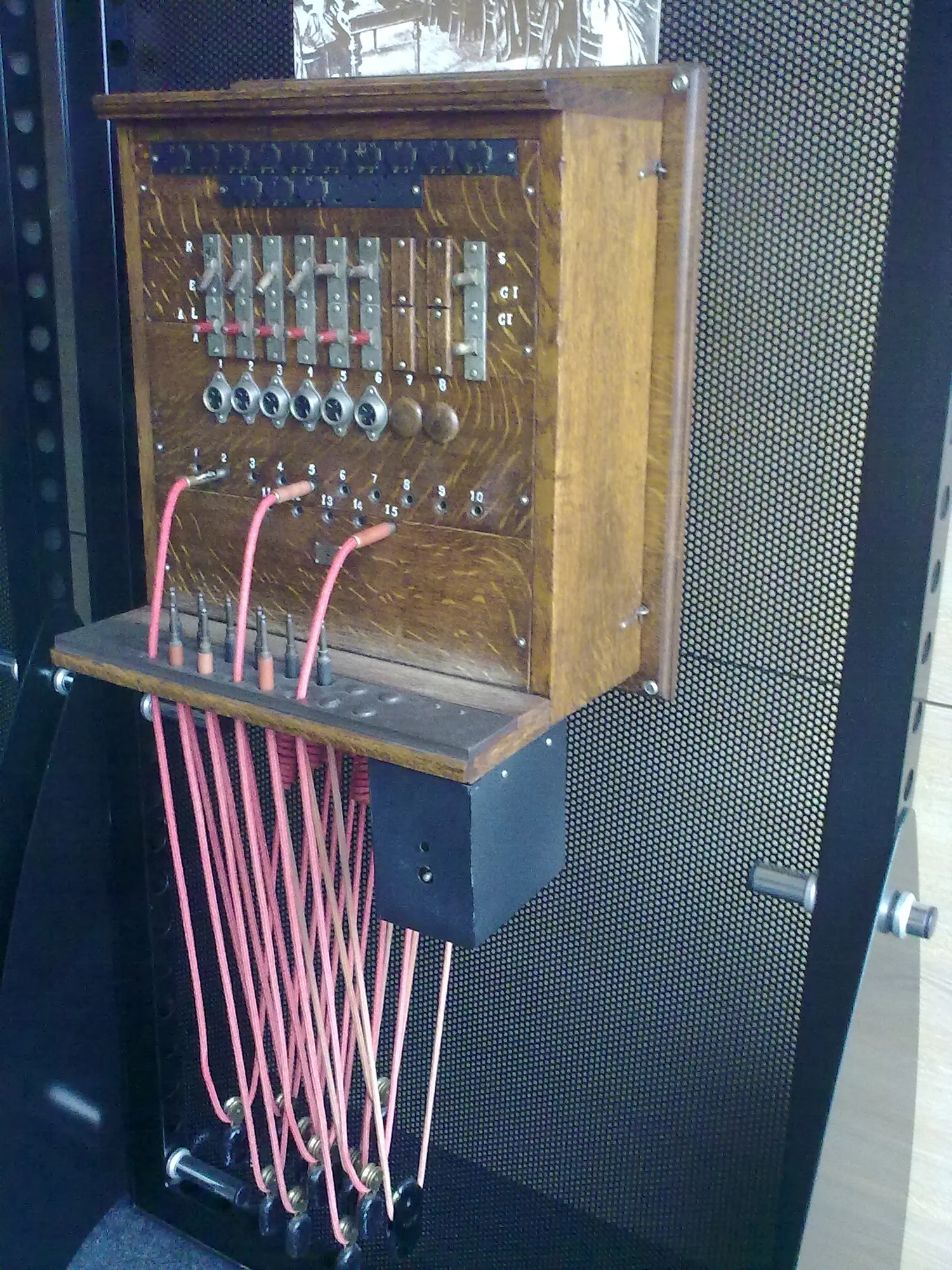
A line of hanging cords is an unusually plain picture of work that can be done and undone. The cords in the cover photograph belong to a preserved manual telephone exchange. Their plugs have somewhere to go, but they do not remain there permanently. A subscriber's connection to an exchange is a lasting arrangement. A call between two people is temporary. The board gives the operator a place where those two kinds of connection can meet.
The Science Museum Group's account of a manual switchboard from Enfield explains that operators linked calls using cords, jacks and sockets. The board in the photograph was photographed in Ghent and is not the Enfield object. The British record helps explain the general role of a manual switchboard; the photograph shows another surviving apparatus. Keep those identifications separate, since details of layouts, signalling and operation varied.
Why each pair of callers did not need a direct line
Consider a village with three places that want to exchange calls: a post office, a home and a shop. Each pair could have its own direct connection. For three locations that is three possible pairings. With six locations there would be fifteen. Adding more subscribers quickly increases the number of pairs. Those simple counts are only an illustration. They make it easy to see the value of bringing subscribers to an exchange and establishing one connection when it is needed.
A temporary path makes another difference. The shop may want to speak to the post office for two minutes and later to the home. It does not need both calls at once. A switching arrangement can reuse common equipment once a call has ended. This is distinct from disconnecting and rewiring every subscriber's line each time. The person at one end keeps the connection that allows a request to reach the exchange. The operator sets up the path that will connect that request to the intended conversation.
It is worth tracing both routes on paper. First draw the subscribers reaching the exchange. Then use a different mark for one path that exists only during a call. By changing that second mark, one can represent a new connection on the same underlying arrangement. A photograph of a board with all its cords stored at rest says little about which calls took place. It shows part of the capacity to create paths, rather than a lasting map of the conversations.
Status had to be visible to somebody
A practical board must give an operator some indication that a caller needs service. Once a call is connected, the operator needs enough information to handle its progress and recover the resources afterwards. Designs have used different signalling arrangements. The presence of a socket is therefore only the beginning of understanding the board. One also needs to know what the operator was supposed to notice, which line it referred to and which controls the operator could use.
An end-to-end description might start with a request from the caller, continue with identification of the destination and finish with clearing down. Within that sequence, a busy destination, a wrong number or a call that has ended are distinct states. A working service needs to distinguish them. No telephone in the exchange has to be clever about all of them independently if the switchboard and operator can manage the appropriate part of the exchange.
A board can look complicated for a surprisingly simple reason: it has to make many pending states visible at once. A visitor sees a row of sockets. An operator needs to know which represent customers, which link to other places and which are currently engaged, depending on the equipment in use. The physical arrangement supports this mental map. Different positions, labels and signals can prevent a person treating a neighboring socket as interchangeable merely because it has the same shape.
A cord can be available while a destination is not
Picture a fictional board handling a few calls. A request arrives from one subscriber to speak to another who is already talking. A spare cord does not free that destination. In a different case, the requested subscriber may be free while no suitable shared resource is available immediately. The two wait conditions look similar to the caller because neither has yet produced a conversation. They have different causes. Distinguishing them is part of explaining capacity.
The same distinction applies to a request involving another exchange. Some part of the route has to reach beyond the local board. In a simple model the local subscriber line, the connection through the local equipment and an available path to another place each have a part to play. A tidy switchboard photograph is poor evidence for reconstructing how a particular distant call was routed. Exact networks need circuit records, operating instructions or other historical sources.
It helps to separate a physical place for a connection from the ability to provide that connection at that moment. The first can be drawn with a clear line and visible endpoint. The second may depend on existing calls, available staff, service links and the time required to set each path up. A busy period does not change the shape of the sockets. It shows what the combined system could do while several people had something to ask of it.
The dial moved a job out of the conversation
The Science Museum Group preserves an early Strowger automatic switch and describes how it used electromagnetic movement to place an arm at a contact, with successive digits selecting different motions. That mechanism made digits part of the selection process. An automatic exchange faced the same broad problem of establishing a path between endpoints. It answered some of the selection questions in machinery rather than relying on an operator to interpret a request and make a connection by hand.
It would be misleading to call every old exchange manual because the telephone pictured nearby is recognisably old. A handset or a wooden case can coexist with very different ways of placing calls. The useful distinction is where decisions happen and how a request is represented. In one arrangement a caller speaks or otherwise signals to ask for an operator's assistance. In another the digits are communicated in a way that produces movement in the switching equipment. Different generations can share the aim of connecting a call without sharing the same user experience.
Nor did automation turn the network into a set of permanent pairings. It provided a different way to choose and release a connection. The contrast with a board of active cords makes this clear. One shows the operator's relationship to the temporary path; the other can show how an instructed mechanism gets to a selected place. The machine needed a physical way to express a connection for roughly as long as it was useful.
Read a silent board as a record of choices
There is another way to inspect the distinction between permanent and temporary connections. A repair crew could investigate a report from a single subscriber who cannot signal the exchange. Another report might say that local calls work but a group of calls beyond the exchange does not. The first observation can direct attention toward one subscriber path; the second could point toward shared links or operating arrangements. In either case a caller's experience remains a fact about the symptom rather than proof about which equipment failed. A switchboard made the shared structure observable to the people trying to locate that distinction.
The sequence of actions at a board also affects how a surviving object can be interpreted. At rest, cords hang in a place where they can be reached. During a call some ends are lifted and the near surface itself becomes a map of ongoing work. A display that secured all the plugs in the sockets could present an impressive pattern while obscuring which positions they ordinarily occupied before a call. A documentary view can mark where the parts are stored, then show which part of the board a demonstration addresses. That distinction is about use rather than about how complete the instrument looks.
A retired switchboard and an operator's account can fill different gaps. The surviving woodwork can show how near a handle is to a seated worker. Instructions or testimony can explain what the operator heard, what signal meant that a caller was waiting and which step confirmed a connection. The physical part is not necessarily the easiest place to recover an audible or procedural signal. The most legible account can let both sorts of evidence carry the parts of the call they still preserve.
A good object description can name who used the board, what kinds of lines were available and how signals were indicated, if those details are documented. It can identify a pictured cord without assigning it to a specific conversation. The apparatus contains the means of making a temporary path, and blank sockets preserve possibilities rather than evidence of actual calls.
The most interesting question at the front of the board is not how many plugs can be counted. Ask what an operator learned first, which next decision was possible and what would release the equipment to someone else. This turns a motionless row of sockets into a readable account of work. Each call gave an enduring line a brief destination. The next call could need an entirely different path through the same place.