What an Ethernet Switch Remembers
An ordinary Ethernet switch can learn where a device’s frames come from without asking for a configuration file. The remembered address describes a route through one local network, not a permanent identity.
In this story 5 sections
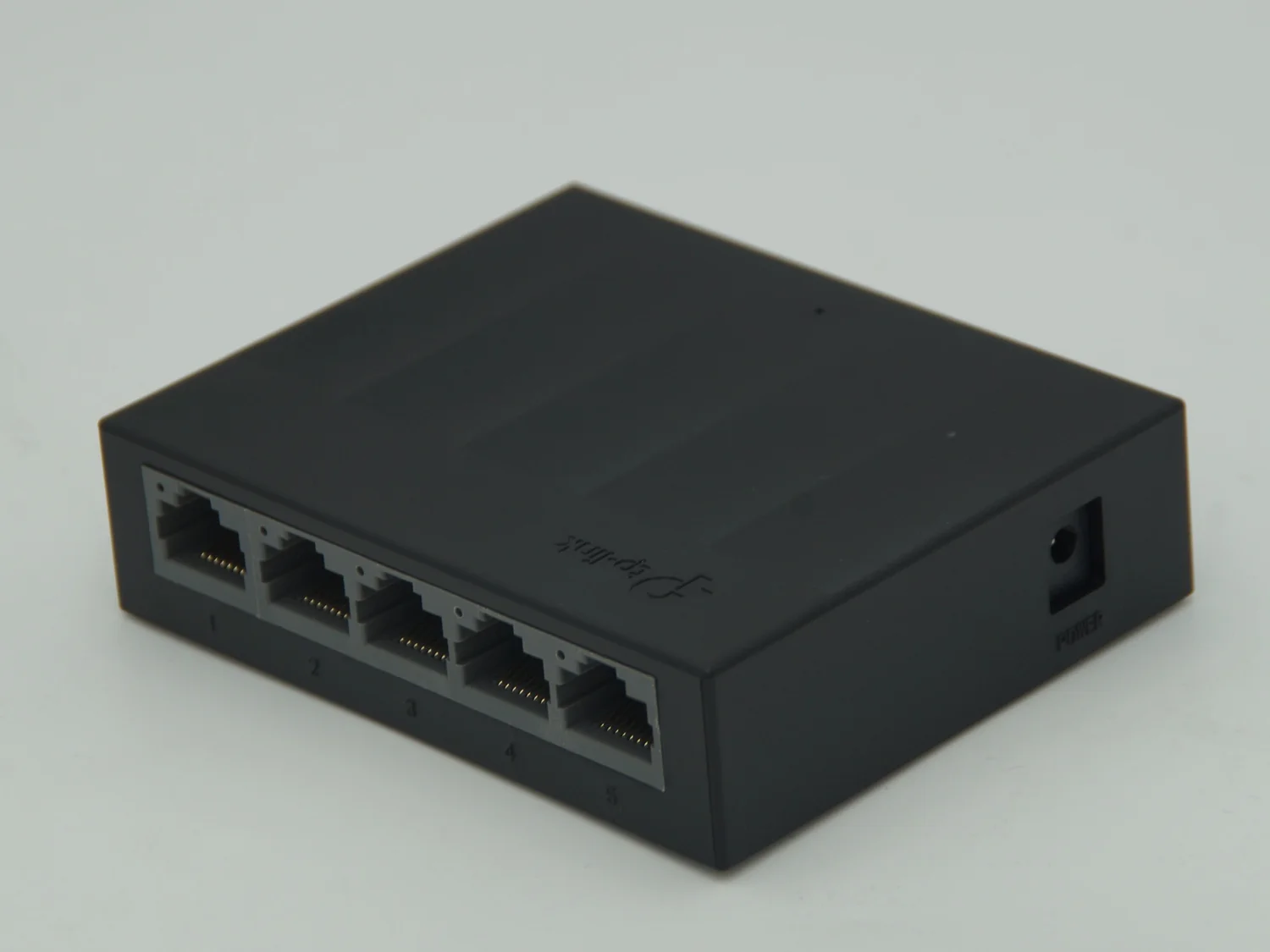
The Ethernet switch in the cover photograph is small enough to be mistaken for an adapter connecting one cable to another. It does provide several places to plug in network links. It also has to decide where to send something that comes in. Sending every frame everywhere would be a poor use of a shared local network. For a great many ordinary frames, the useful action depends on a small history: the switch has already observed where a destination's traffic came from earlier.
Cisco's description of an Ethernet switch explains dynamic learning by source address and later forwarding by destination address. Those two phrases are easy to reverse. The source of an incoming frame tells the switch where it recently saw some device send from. The destination tells the switch which previous observation could be useful now. One is a clue about where a device has been seen. The other is a request to reach it.
The first bit of traffic supplies a location
Consider a fictional switch with three connected paths. A workstation sends a frame into the first port. The switch can associate the source MAC address with that port in the applicable local switching context. A MAC address is a link-layer identifier used in Ethernet frames. The port is a place where the switch receives and sends on a link. A remembered association between them gives future traffic towards the workstation a direction to take.
Notice that the source address can be learned even when the frame was sent to another device. It gives a clue about where a future frame destined for the workstation could be forwarded. If that future frame arrives from a second port and the address remains associated with the first, the switch can generally direct it to the first rather than send it out to every connected path. That is why two local conversations can be understood without giving every receiver every frame.
The switch has learned where the address was seen, not a description of the person who used the workstation or a verified inventory record for the building. A port could lead to another switch and have traffic from several devices behind it. The individual table entries can all point in the same general direction. Looking at a row of entries does not establish which device is physically attached to the first switch by a cable or how long a port will remain its path.
A destination can be unknown even in a working network
At some moments an arriving frame has a destination that the switch has not yet learned. An ordinary switching behaviour is to send an unknown unicast frame onward through eligible ports within the same local segment, except where it arrived, subject to the configuration and rules of the equipment. This is a way to keep delivery possible without a current entry. Once the destination sends its own traffic, its source can be learned and later delivery can become more selective. The point is ordinary forwarding behaviour, not a reason to generate unfamiliar traffic on a network.
Broadcast is a separate case. Some traffic is deliberately addressed to a broader audience for a local purpose. An Ethernet switch does not treat that as if it were simply missing an entry for one known recipient. A useful explanation distinguishes a specific but unknown destination from one addressed more widely by design. Seeing that traffic can reach more than one port does not on its own tell you which of these cases is present. You have to know the destination type and the context in which the switch is working.
This distinction has a practical limit in any diagram of a real network. A managed switch can separate traffic into virtual local area networks, or VLANs, with rules defining which ports and traffic belong to each. A drawing showing three cables on one chassis does not establish that each can reach the others as if they were in one local segment. The physical switch and the grouping of traffic both need to be understood before drawing a conclusion about where an unknown frame would go.
An old entry is useful only while it describes a real path
A device can be moved to another jack or simply stop sending for a long interval. Dynamic entries can age out. Cisco's documentation distinguishes dynamic entries learned by the switch from static ones supplied by a management configuration. The applicable timing and behaviour depend on the device and settings. There is no reason to attach one default number to every switch just because a particular guide gives an example. What matters is that a learned observation does not need to remain useful forever.
Imagine two meetings in the same office, one before a computer is moved and one after. If an authorised administrator takes a table snapshot in each, they can compare where the same address is seen. A cable route may have changed, or a connection through another switch may now be the useful direction. The snapshots need times and relevant context. A table collected today cannot be made to settle which route a frame used yesterday after the physical setup changed.
Keeping several observations also helps the person distinguishing ports from endpoints. A message such as this port shows twelve addresses can be entirely compatible with a link to another device that forwards traffic for several endpoints. It could be surprising if the expected setup contains just one directly attached endpoint with no other related equipment. Asking which topology was intended is more useful than presuming one learned address per jack from the start.
The table is not what a router or a directory remembers
MAC learning describes a path within the Ethernet switching context. A router's decision to forward between networks concerns a different kind of address and a different part of a journey. Some devices can perform both functions. That does not make the records interchangeable. A name learned through DNS, an address selected for a connection and a MAC address visible on one local link belong to different questions. One user action can give rise to traffic that calls for all three without turning any one table into the whole network map.
In a simple picture, put two local groups on opposite sides of a router. A switch on one side can learn which direction local frames come from. Reaching an application on the other side still depends on what happens beyond that first switch. A local link can be up and learning while a route to a remote service is unavailable. A useful issue report says whether local traffic is working and which remote step failed rather than treating a good local connection as proof of complete reachability.
An ordinary unmanaged switch often does this learning without exposing a screen for the observer to read. The photo illustrates an example of hardware. An official guide to a managed device can explain a table that someone with authorised access can inspect, but its commands and options should not be assumed to apply to a different model. The useful idea can be carried over without supposing the same management interface is hidden behind every case.
Read an entry as a statement with conditions
The port number can be brought into a maintenance record without being used as the name of a person or computer. A label on a patch panel might say which wall outlet is connected. A switching table may say where it observed an address. An equipment record can identify the machine assigned to the desk. Those records can agree and still be evidence of three different things. If an address is seen beyond another switch, the first record might be closer to what is physically present while the second continues to describe which direction is useful for traffic.
The source and destination distinction can be reviewed with a purely hypothetical example on paper. A sends to B from the first port, and later B sends to A from a second port. The observation of A belongs to the first arrival. The next arrival identifies where the switch sees B. This makes it possible to explain a later directed transfer without assuming the switch had to be told both endpoints in advance. These names are symbols for a local example, not computer or account names. That is enough detail to show how learning can be a consequence of ordinary communication rather than a separate registration ceremony.
A port light may show activity without revealing any of these associations. It answers whether the local interface sees a particular condition, while the remembered path concerns a frame address. Treat them as distinct evidence during authorised maintenance.
Translate a table row into a sentence: in this switching context, this source was observed through this connection. It is a modest sentence. It does not give ownership, identify an account, describe the whole cable run or offer independent proof that a destination's application is online. Adding the time and context can make it useful whether a person is trying to explain normal local traffic or understand a change after a move.
The photograph makes the switch look like a group of places to plug in. In operation it is more useful than that because it can turn incoming frames into observations for later use. The observations expire, are revised or are checked against the configuration. What a switch remembers is a short map of useful directions. The next frame supplies the question that makes one of them worth consulting.