The Contactless Card That Borrows Power
A plastic card can answer a reader without carrying a battery. A small antenna and a short-lived exchange explain how.
In this story 6 sections
The tap symbol on a card gives a good instruction about where to hold it. It says very little about what is going on inside the plastic. There are no batteries to change and no inlet for a charging cable. Leave the card in a drawer all winter and it can still answer next time it is held to a suitable reader. The energy for that brief conversation was never supposed to come from the drawer or stay in the card.
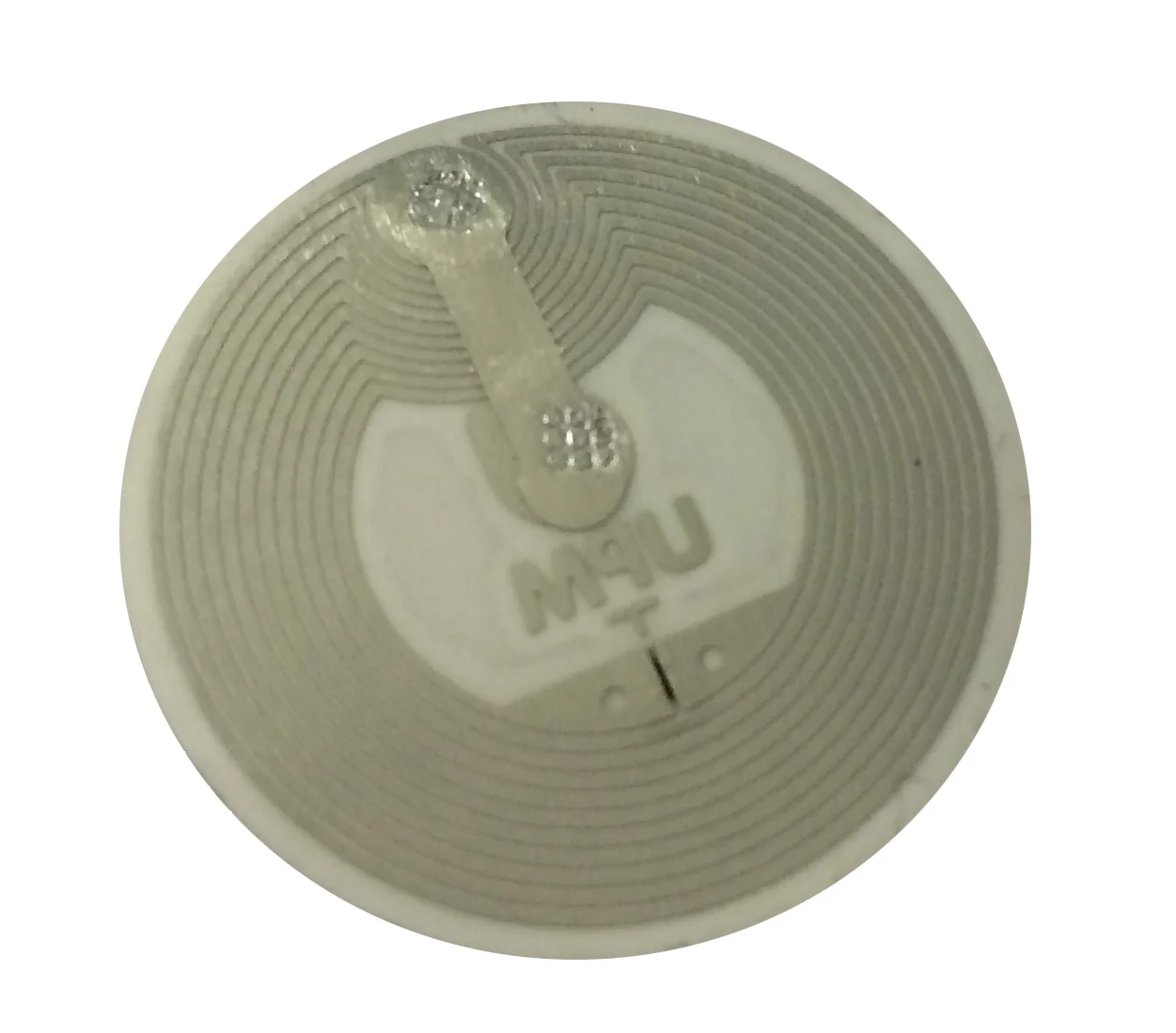
The small NFC tag in the photograph puts one part of the explanation where it can be seen. A loop runs around the outside of the assembly. That shape has a job that can also be hidden in a card: it couples the electronics inside to a field outside. The two objects can come very close without sharing an electrical terminal. The interesting thing about the word contactless is that it describes the link, while most of the momentary work takes place on either side of that link.
The reader does the first work
A reader has a power source. It can be part of a terminal connected to a building supply or part of a handheld device that runs on its own battery. When it is looking for a compatible passive tag, it uses its antenna to produce a changing electromagnetic field. In the near field, the changing magnetic field through a nearby loop induces an electrical signal in that loop. Someone tapping a card initiates the encounter in the ordinary sense of the word; the powered reader initiates the exchange in the engineering sense.
The loop inside a card usually occupies enough of the flat surface to be a useful antenna. Current does not cross the layer of air or plastic as it would across the contacts of a plug. The field links the two loops. The layout is also different from a radio station that aims to cover a city. Coupling varies sharply enough with placement that a marking on the reader is practical: it directs a user to the small part of a larger enclosure where an ordinary tap is expected to work.
The NFC Forum distinguishes reader mode from card emulation, in which a device can present itself as a card. The flexible device that you carry in your pocket can therefore have different roles in different encounters. A battery in that device does not imply a battery in the plain cards that it may be capable of reading, and a reader built into a phone need not behave like a card during the same operation.
Turn oscillation into a working supply
The field is changing quickly. The electronics in a passive tag need usable power rather than an alternating signal passed straight into every part of the chip. A circuit inside the tag rectifies the induced signal so the device has a supply while it is in the reader's field. The circuit need only support the small task it was made for. It may read stored data, interpret a request or prepare an answer, depending on the particular chip and application.
Think of the time scale from the perspective of a card on a kitchen table. For most of its existence, there is no current from a reader available to it. The data it is supposed to retain can live in nonvolatile memory, which does not require a continuous supply to keep its contents. Put the card near an appropriate reader and the electronics borrow enough energy to enter their working state. Move it away and that supply disappears. The ability to start up again belongs to the coupling and the circuitry; the ability to keep the stored information between encounters belongs to the memory.
This also separates two meanings of the phrase the card died. An old tag might no longer operate because its loop was damaged or separated from the chip. There is no implication that it should be charged. A different card might communicate normally while a service considers it expired. A useful diagnosis starts with which part of that small story someone actually observed.
The reply can travel on the reader's field
Sending a message back sounds as though the card would need a small broadcast transmitter. In passive operation it can alter how its circuitry loads its antenna instead. The changes in load affect the signal detectable at the reader. If the card changes that load in an agreed pattern, the reader can interpret the small variations as an answer. STMicroelectronics calls this load modulation in its technical guide. It is the partner to modulation by the reader when the reader sends data to the tag.
Imagine two people listening to the same vibrating surface. One is driving the vibration and the other can touch the surface lightly to make a detectable change in it. That gives a rough analogy for a reply made by changing an existing signal. The tag does not have to create the field from scratch. The useful effect is very small, and the receiving circuit is designed to separate it from the much stronger carrier of its own making.
It is helpful to keep the antenna's two roles in the same picture. It is part of the path by which the tag obtains power, and it is also part of the path by which it communicates. If the tag cannot draw enough power while it is held up to a reader, there may never be a message to interpret. If it has enough power, the two devices still have to speak in compatible ways. One condition makes the other possible; it does not settle it.
Position is a feature of the link
In an everyday product the location of the antenna is usually concealed. A large reader can have a small target marked on it. A card may be broad enough to cover that mark in several positions, while the actual loops align well in only some of them. Moving the card slightly or giving it time against the marked area may make the difference in a normal interaction. There is no need to infer a general operating distance from one successful tap with one reader.
The materials near an antenna also matter. A loop hidden in a sticker designed to stand alone may behave differently if it is placed against metal; tags meant for a metal surface can be constructed for that setting. Likewise, a designer may choose different antenna shapes for a small label and a rectangular card. The requirement is to obtain a reliable exchange in the place where the product will actually be used. A neat shape on a drawing is only one part of checking how it will work.
The most informative label on a reader gives people a stable location to aim at. The next useful detail is feedback a person can see or hear. Even on a very good link the events are too small and too quick to observe directly. Someone holding a card needs evidence from the equipment that it is time to remove it, make a choice or wait for an answer. That is a design problem at the interface even when the circuit works exactly as intended.
A reply is one step in a larger decision
A tag on a gallery sign can store a reference to a page with more information. A suitable device can read that reference and decide whether to present it. At a transport entrance or a shop terminal, the purpose is different. A card can communicate successfully while the surrounding service declines a transaction or waits for more information. A person sees one reader and a single tap, but the radio exchange and the decision supported by that exchange belong to different parts of the system.
That distinction makes descriptions more useful. A note saying that the reader showed a response and then displayed a specific message is more helpful than saying the card did not work. It preserves evidence about whether the error occurred before or after communication. On a gallery sign, an accepted link that then leads to an unavailable page still tells the maintainer the tag did a job. Repairing the web page and replacing the tag are different tasks.
The stored payload on a basic information label should also be understood as data. Where it came from, what a device should do with it and what a service should authorize involve decisions at a different level. Those decisions can vary with the product. One antenna design does not tell us what data an application expects or what happens to it once a reader receives it.
Look at the plastic again
The little loop in the photograph can be considered as an object in its own right. Its size determines where it will fit. Its placement affects how well it will meet the reader's field. The chip it serves needs a place in the assembly without giving the user another contact to align or another battery to maintain. All of this has to work within a gesture that people usually perform at the pace of an ordinary errand.
Once the reader is absent, the card can go back to being an unpowered object. At the next encounter, a new field brings it briefly into operation, and the card changes that field just enough to make an answer. The tap works so well as a public instruction because nobody has to manage the power separately. Engineers built the supply and the exchange around the same small act of bringing two things near each other.