A Shutter That Finishes by Rows
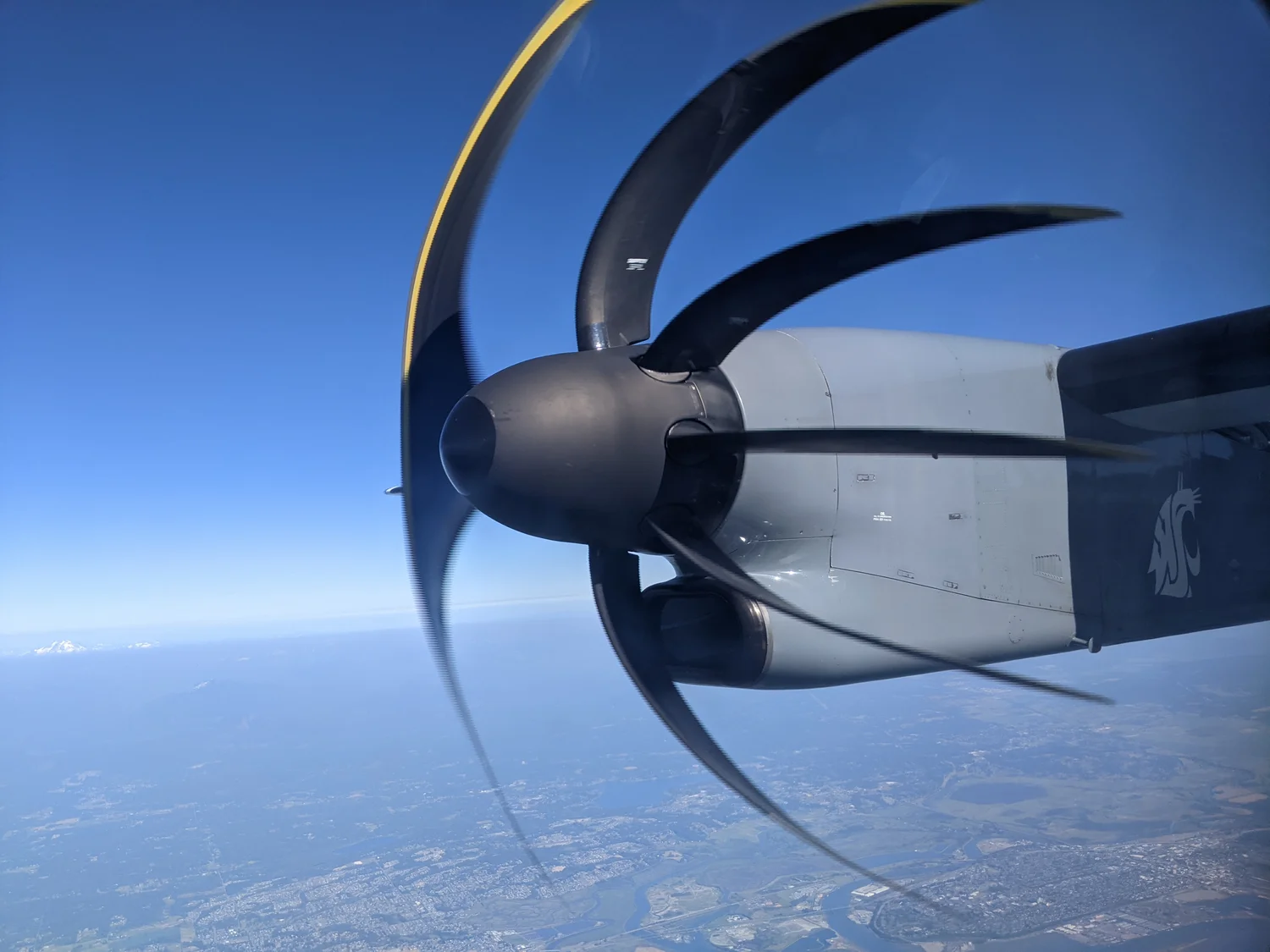
A bent propeller in an untouched photograph shows what happens when a camera gives different parts of a frame different times.
In this story 5 sections
The view out of the aircraft window gives you a useful straight reference: a trim line, a seam in the wing, the edge of a panel. Then the propeller appears. What ought to be a set of blades joined at one hub looks like pieces of a curve that were never attached. A phone picture of this kind can look so implausible that people assume it was edited. The strange outline can be made entirely in the camera. In the photograph here, the photographer identifies the aircraft as a Dash 8 and the phone as a Pixel 3.
Think about what it means to say a picture was taken at a certain moment. The photographer aimed once, pressed once and received one frame. It follows that the photograph counts as one picture; it does not follow that every part of that frame saw the same interval of time. A rolling shutter can expose rows in sequence, so different portions of the scene are recorded at slightly different times. Most of the scene may look the way you expect. The part that moves rapidly is the part that betrays the schedule.
Keep two clocks
A useful first drawing is a grid four rows high. Give the first row a short bar representing its exposure. Start an identical bar slightly later for the next row, shift the third bar later still, and then do the same for the fourth. The bars might overlap substantially. In any case they begin at different points along the horizontal axis. That is the feature to keep in mind when thinking about rolling exposure. The direction in a real image depends on the sensor, the mode and the orientation in which the image is shown.
The length of any one bar is the time its row collects light. An object can move during that time and leave a blur within the row or its neighborhood. Another number is the interval between the capture times at different ends of the grid. During that longer traversal the object can occupy markedly different positions. Shorten the bars without making the interval between their starts much smaller. The object may then look sharper in each row while its edges still fail to line up from row to row. This is why a short exposure setting alone is not a reliable cure for skew.
A global shutter gives the photosensitive part of each pixel an exposure interval aligned in time with the other pixels, within the limits of the design. It can still take time to transfer the information off the sensor. Capturing the light and subsequently transporting the data are different tasks. When reading a spec sheet, the rate at which a camera delivers pictures, the individual exposure time and the timing difference across a rolling frame all deserve their own lines. The easiest number to find in a store listing might be the least helpful one for the motion you care about.
Follow one edge through a frame
Suppose a toy train has a tall, straight door seam. Its train is moving from left to right while a sensor presents rows from the top of the image down for purposes of this example. The row that includes the top of the seam is exposed at one instant; when the rows that contain the lower part are exposed, the train has moved to the right. The points that eventually make up the photographed seam stack into a slant. No part of the model’s plastic door had to bend.
Change the direction of travel with the same exposure sequence and the slant can reverse. In a real picture the camera can also move. Pan rapidly across a fence, and stationary posts sweep across the sensor. They may slant for much the same geometrical reason. You can make an easy comparison by pointing at a bookcase from a stable position and then making a modest pan across the same vertical edges. Repeat gently in the opposite direction. If the effect is visible with your equipment, fixed lines will shift their tilt or apparent shape in a way that a crooked bookcase cannot explain. Compare a still image and video mode separately because they need not use the same readout.
A photograph is not a timing chart. Lens distortion can bow straight lines near the edges of a wide image. Perspective makes verticals converge when a camera tilts. Hand movement can smear fine detail, and stabilization can modify the shape of a video, particularly near the edges. A second exposure from the same place, with the camera steady and the movements stopped, is a better comparison than a second photograph taken from a completely different angle. It gives those other explanations fewer things to work with. A single odd line can be a valuable prompt. It is weak proof of any one cause.
Why a spinning blade is especially persuasive
The door seam has a simple way of translating while the camera works through the rows. A blade changes angle as it goes. Its tip crosses more of the image than the section near the hub does in a comparable time interval, and the separate blades occupy different arcs. At one row the camera records a bit of the blade at one angle; at another it may record a bit during a considerably later part of the rotation. The assembled image can suggest disconnected pieces.
The subject does not need to reflect or bend light in any unusual way. The fixed parts of the aircraft emphasize how local the effect can appear. The whole photograph was made with the same camera, but the bracket, window and far scenery did not sweep their edges through the image like a propeller did. A complicated shape concentrated in the moving part is unsurprising once you know what the sensor is doing. It can still be astonishing to look at.
It would be difficult to infer the blade geometry or the aircraft’s power setting from the published picture alone. A camera mode, the orientation and timing of the sensor relative to the photographed motion, and the blade’s shape and speed would all bear on the inference. A processed phone image may introduce additional complications. It is reasonable to explain why the effect is possible and decline to estimate engine speed. The photograph gives us a visual illustration, not the equipment needed to make all possible measurements.
Compare two kinds of unwanted shape
Imagine a phone set on a table while a plain paper flag moves through the view. Draw a dark vertical line on one edge. If movement makes the line a wide gray streak, a shorter exposure may improve your ability to pick out the line. If the line has a sharp edge whose location shifts steadily as you trace it down the image, the rows may have different corresponding locations in time. It is possible to have both properties in a single shot. Look for the width of the edge and the position of its center separately. That small distinction helps when you compare frames by taking screenshots and zooming in.
An indoor experiment may also produce light bands. A lamp that changes output on a short cycle can strike different rows at different brightnesses, because the rows are not integrating light over an identical interval. A moving lamp or moving object is not necessary for the effect. This branch of the same problem gives photographers a warning when they interpret banded pictures: curved rails and light stripes can both involve timing, even though they are entirely different things in the room. For a first demonstration of geometry use broad, steady natural illumination and leave lights that flicker as a separate test.
There are times when neither distortion matters. A short clip from a table showing a person speaking with few quick gestures may look entirely ordinary. If there is only one chance to photograph a fast subject, though, reviewing the background anchor and the moving outline on an early frame is more useful than judging the overall sharpness from a thumbnail. A puck, golf swing or fast passing car may expose limitations that the same settings at a picnic never did.
Pick a camera mode around what the frame must show
For many ordinary subjects you can reduce the visible problem by changing a simple part of the recording. A camera that moves slowly across the scene lets fixed edges spend less of the readout interval moving appreciably across the frame. A view from a greater distance can make motion smaller in pixel terms, though settling for that view changes detail and composition. Another mode advertised to read out faster may be a possibility; test the actual resolution and crop you intend to deliver. A little distortion that goes unnoticed in a team video could be significant in a technical record that someone will use to measure a part.
For comparison, keep a short note listing the mode, whether the camera and subject moved, and whether the effect appeared near the center or only at one edge. Take the same note for a reference image with nothing moving. That is often enough to separate a visibly distorted setup from a setup worth testing further. A shop name for the shutter may send you toward the right page of a manual. The notes tell you whether the camera and the rest of the arrangement suit the picture you wanted.
One can also decide to keep the surprising frame. A shaped blur or a curved blade can tell someone what a sensor did that a clean, unremarkable view would hide. The photograph outside this aircraft window gives us several things at once: a real propeller in motion, a fixed frame of reference, and visible evidence that the timing inside the camera matters. A simple label under the image makes it easier to admire the result without confusing it for the shape of a physical blade.